Thousands of preventable workplace injuries happen each year because of improper machine servicing. The root cause? A missing or poorly managed lockout tagout log sheet. It’s not just paperwork—it’s a legal requirement and a frontline defense against hazardous energy releases. Yet, many facilities still rely on disorganized notes, memory, or no record at all. If your team can’t produce a completed LOTO log sheet in under 60 seconds during an audit, you’re at risk.
A printable lockout tagout log sheet brings structure to energy control procedures. It documents every lock applied, who applied it, when, and why. More importantly, it creates accountability, ensures proper communication during shift changes, and supports OSHA compliance. This guide delivers ready-to-use templates, best practices for implementation, and real-world workflow tips that go beyond basic checklists.
Why a Printable LOTO Log Sheet Is Non-Negotiable
Lockout tagout (LOTO) isn’t just about slapping a lock on a switch. It’s a documented process. OSHA standard 29 CFR 1910.147 mandates that employers establish a written energy control program, including procedures and periodic inspections. Central to that program is documentation—and the log sheet is the daily record-keeper.
Without a printable log sheet: - Workers may bypass steps during high-pressure maintenance - Shift handovers become dangerous guessing games - Audits reveal missing data, leading to citations - Incident investigations lack critical timeline context
A well-designed printable form standardizes the process across teams and equipment. It forces verification at every stage: preparation, shutdown, isolation, lock application, stored energy release, and clearance.
Example: At a Midwest food processing plant, a technician re-energized a conveyor without checking the log. Another worker was still inside the guard. The near-miss was traced directly to a missing log entry. Within a month, the facility adopted a mandatory printable LOTO log sheet with signature fields and equipment IDs—dramatically reducing procedural gaps.
Key Elements of an Effective LOTO Log Sheet
Not all printable templates are created equal. A weak form leads to incomplete data. A strong one guides the user through the entire LOTO sequence. Include these components:
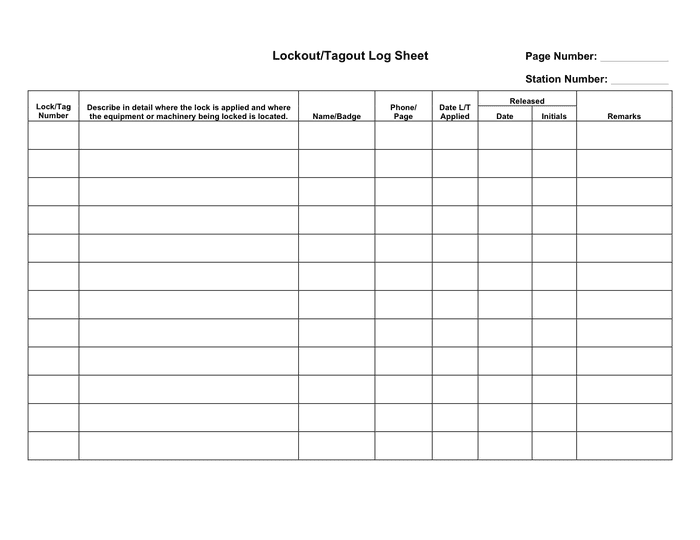
- Equipment ID/Name: Specific identifier (e.g., “Conveyor Line 3” or “Pump #12”) to prevent confusion.
- Date & Time of Lock Application: Crucial for tracking duration and shift accountability.
- Employee Name & ID: Who applied the lock? Use employee ID to avoid ambiguity.
- Department/Shift: Helps during multi-shift operations.
- Reason for Lockout: Brief description (e.g., “Motor replacement,” “Guard repair”).
- Lock Number/Tag ID: Each lock should have a unique identifier tied to the individual.
- Verification of Isolation: A checkbox or line confirming energy sources are isolated and tested.
- Clearance & Removal Signature: Who verified the area was clear before removal?
- Time of Unlock: Final step to close the loop.
Pro Tip: Add a field for “Additional Notes” to capture unexpected delays, secondary locks, or equipment quirks. This becomes invaluable during incident reviews.
Free Printable LOTO Log Sheet Templates
A standardized, printable format ensures consistency. Below are three practical templates you can copy or adapt. Print them in bulk and store near high-risk equipment or in LOTO kits.
#### Template 1: Basic Daily LOTO Log (Single Equipment)
| Field | Entry Space |
|---|---|
| Equipment Name | ___________ |
| Date | ___________ |
| Start Time (Lock On) | ___________ |
| Technician Name | ___________ |
| Employee ID | ___________ |
| Department | ___________ |
| Reason for Lockout | ___________ |
| Lock/Tag Number(s) | ___________ |
| Verified Isolation? | ☐ Yes |
| Clearance Verified By | ___________ |
| End Time (Lock Off) | ___________ |
Best for: Small workshops or single-operator maintenance.
#### Template 2: Multi-Person Lockout Log
Designed for group maintenance where multiple employees apply locks.
- Equipment: _________________________
- Work Description: ___________________
- Supervisor: ________________________
| Employee Name | ID | Lock # | Applied (Time) | Removed (Time) | Signature |
|---|---|---|---|---|---|
Includes: Pre-job briefing checkbox, post-job verification, and space for tool inventory.
Best for: Industrial plants with team-based servicing.
#### Template 3: Monthly LOTO Audit Checklist (Companion Form)
Use this to audit your log sheets monthly:
- ☐ All log entries are complete
- ☐ Lock numbers match master key
- ☐ No unsigned removals
- ☐ Stored energy release confirmed
- ☐ Training records up to date
- ☐ Equipment-specific procedures available
Attach this to your monthly safety report.
Common Mistakes That Undermine LOTO Logs
Even with a printable sheet, teams fail due to procedural shortcuts. Watch for these:
- Backdating Entries
- “We’ll fill it out later” turns into never filled out. Real-time documentation is non-negotiable.
- Using Generic Equipment Names
- “Machine 1” is useless. Use asset tags or serial numbers.
- Skipping the Verification Line
- No signature = no proof of isolation check.
- Shared Locks or Tags
- Each worker must use their own lock and tag—personal accountability matters.
- Storing Logs in the Wrong Place
- If the log is in an office while maintenance happens on the floor, it won’t be used.
Real Case: An auto parts factory was fined $28,000 after OSHA found 70% of LOTO logs were either missing or had blank verification fields. The form was available—but stored in the safety manager’s office, not on the shop floor.
How to Integrate Printable Log Sheets Into Your Workflow
A form on paper only works if it’s part of the routine. Here’s how to embed it:
- Pair with LOTO Kits
- Store a stack of printable logs inside each LOTO kit alongside locks, tags, and hasps.
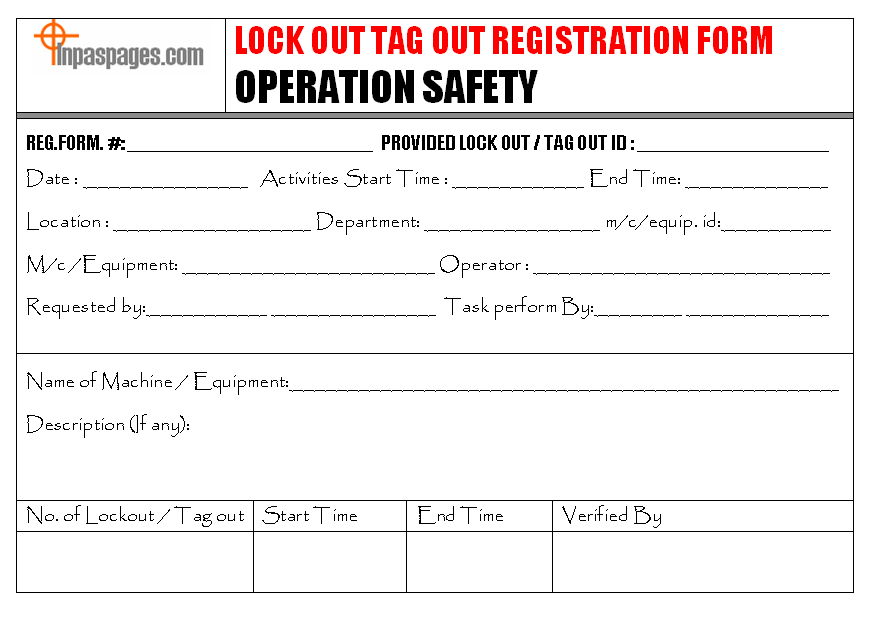
- Require It in Procedures
- Update your SOPs: “No maintenance begins without a completed log.”
- Assign Log Custodians
- Designate a lead technician per shift to collect and file completed sheets.
- Conduct Monthly Log Reviews
- Audit 10% of logs each month. Look for trends—repeated late entries, missing data.
- Use Logs in Training
- During refresher training, walk through real (anonymized) log entries to show gaps.
Pro Tip: Laminate a copy and keep it on a clipboard near high-frequency machines. Use wipe-off markers for daily reuse—just ensure a permanent copy is archived.
Digital vs. Printable LOTO Logs: When to Use Which
While digital LOTO systems are rising—especially in smart factories—printable logs still dominate in mid-size and legacy operations.
| Factor | Printable Logs | Digital Systems |
|---|---|---|
| Cost | Low (paper + printer) | High (software + hardware) |
| Accessibility | No power or network needed | Requires devices & charging |
| Audit Trail | Physical, tamper-evident | Timestamped, encrypted |
| Real-Time Visibility | Limited | Dashboards, alerts |
| Training Curve | Minimal | Requires onboarding |
Best Practice: Use printable logs if you have: - Under 50 employees - Limited IT infrastructure - Remote or outdoor equipment - Frequent temporary staff
For larger facilities, consider hybrid models: printable forms with daily photo uploads to a central system.
Industry-Specific Use Cases
#### Manufacturing Plant A CNC maintenance team uses a multi-lock log sheet. Each technician applies a lock, logs their time, and signs out upon completion. Supervisors review logs weekly to spot bottlenecks.
#### Commercial HVAC Technicians print a log before servicing rooftop units. The form includes space for refrigerant type and pressure readings—integrating LOTO with broader safety checks.
#### Water Treatment Facility Due to rotating shifts, they use color-coded printable logs (red for day, blue for night). This helps track extended lockouts and prevents miscommunication.
Where to Get Reliable Free Templates
Don’t reinvent the wheel. Use trusted sources:
- OSHA.gov – Offers basic LOTO forms and compliance guides.
- National Safety Council (NSC) – Downloadable templates with visual aids.
- EHS Daily Advisor – Industry-specific printable logs.
- SafetySmart – Free customizable PDFs for small businesses.
- Template.net – Professionally designed, ready-to-print options.
Always customize templates to match your equipment and workflow. A generic form is better than none—but a tailored one is far more effective.
Final Step: Make It Stick
A printable lockout tagout log sheet only works if it’s used consistently. Post it where it’s needed, train on it regularly, and treat every blank field like a red flag. Audit your logs as rigorously as your equipment.
Start today: Print five copies of a basic LOTO log, place them in your three highest-risk zones, and run a drill. Refine based on feedback. Compliance isn’t about perfection—it’s about progress. And the right printable sheet is the simplest tool to drive it.
FAQ
What should you look for in Lockout Tagout Log Sheet Printable: Free Templates & Best Practices? Focus on relevance, practical value, and how well the solution matches real user intent.
Is Lockout Tagout Log Sheet Printable: Free Templates & Best Practices suitable for beginners? That depends on the workflow, but a clear step-by-step approach usually makes it easier to start.
How do you compare options around Lockout Tagout Log Sheet Printable: Free Templates & Best Practices? Compare features, trust signals, limitations, pricing, and ease of implementation.
What mistakes should you avoid? Avoid generic choices, weak validation, and decisions based only on marketing claims.
What is the next best step? Shortlist the most relevant options, validate them quickly, and refine from real-world results.